SLA – Tough 1000 Resin
Tough 1000 is a ductile, impact-resistant resin for SLA 3D printing that performs like high-density polyethylene (HDPE). With 180% elongation at break and more than 100,000 flex cycles, parts bend, compress, and recover without cracking. Its smooth, low-friction surface suits moving assemblies, and it replaces Formlabs’ earlier Durable Resin with higher fracture toughness.
What Tough 1000 Is Best For
- Impact-resistant jigs and fixtures for repeated use on the production floor
- Living hinges and compliant mechanisms that flex repeatedly
- Snap-fit enclosures, clips, and assemblies
- Low-friction parts such as joints, linkages, ball joints, and wear components
- Functional prototypes and end-use parts that must bend without breaking
When another material is a better fit
- Need more stiffness, like polypropylene: Tough 1500
- Need ABS-like stiffness and strength: Tough 2000
- Need a rubber-like part: Flexible 80A
Key Material Facts
- Tough 1000 performs like HDPE: ductile, impact resistant, and fatigue resistant
- Elongation at break: 180%
- Ross flex fatigue: more than 100,000 cycles
- Unnotched Izod: no break; Gardner impact: 14.5 J (128 in-lb) at 1.6 mm
- Work of fracture: 3200 J/m²
- Smooth, low-friction, matte dark gray surface
- Heat deflection temperature: 55°C (132°F) at 0.45 MPa
- UL 94 HB flammability rating
- Parts can be printed solid and air and fluid tight right off the printer
- Works with glue joints and light welding; printed threads are possible, but Helicoil inserts are recommended
- Resists water, oils, diesel, bleach, and mild acids and bases; swells in xylene, gasoline, butyl acetate, and acetone
Tough 1000 Material Properties
Version note: we currently print with the latest version of Formlabs Tough 1000 Resin.
Mechanical, thermal, and electrical properties (post-cured, from Formlabs’ published data sheet)
| Property | Metric | English | Method |
|---|---|---|---|
| Ultimate tensile strength | 26.3 MPa | 3810 psi | ASTM D638-14 |
| Tensile modulus | 932 MPa | 135 ksi | ASTM D638-14 |
| Elongation at break | 180% | 180% | ASTM D638-14 |
| Flexural strength | 29.0 MPa | 4210 psi | ASTM D790-17 |
| Flexural modulus | 761 MPa | 110 ksi | ASTM D790-17 |
| Notched Izod | 72 J/m | 1.3 ft-lbf/in | ASTM D256-10 |
| Unnotched Izod | No break | No break | ASTM D4812-11 |
| Notched Charpy | 9.0 kJ/m² | 4.3 ft-lbf/in² | ISO 179-1 |
| Gardner impact (1.6 mm) | 14.5 J | 128 in-lb | ASTM D5420-21 |
| Work of fracture | 3200 J/m² | 219 ft-lbf/ft² | ASTM D5045-14 |
| Ross flex fatigue | >100,000 cycles | >100,000 cycles | Internal (23°C, 30°, 1 Hz) |
| Shore hardness | 68D | 68D | ASTM D2240 |
| Heat deflection temperature @ 0.45 MPa | 55.3°C | 131.5°F | ASTM D648-16 |
| Heat deflection temperature @ 1.8 MPa | 44.6°C | 112.3°F | ASTM D648-16 |
| Thermal expansion (0–150°C) | 168.2 µm/m/°C | 93.4 µin/in/°F | ASTM E831-19 |
| Flammability | HB | HB | UL 94 |
| Dielectric strength | 15.1 kV/mm | – | ASTM D149-20 |
| Volume resistivity | 4 × 10¹⁵ Ω·cm | – | ASTM D257-14 |
Tough 1000 solvent compatibility
Percent weight gain over 24 hours for a printed and post-cured 1 × 1 × 1 cm cube immersed in each solvent.
| Solvent | 24 hr weight gain, % |
|---|---|
| Acetic acid 5% | 0.2 |
| Acetone | 30.4 |
| Bleach ~5% NaOCl | 0.0 |
| Butyl acetate | 38.9 |
| Diesel fuel | 0.7 |
| Diethylene glycol monomethyl ether | 6.9 |
| Hydraulic oil | 0.1 |
| Hydrogen peroxide (3%) | 0.2 |
| Isooctane (gasoline) | 39.8 |
| Isopropyl alcohol | 6.9 |
| Mineral oil (light) | 0.0 |
| Mineral oil (heavy) | 0.1 |
| Salt water (3.5% NaCl) | 0.2 |
| Skydrol 5 | 5.0 |
| Sodium hydroxide solution (pH 10) | 0.2 |
| Strong acid (HCl, concentrated) | 7.3 |
| Tripropylene glycol monomethyl ether (TPM) | 7.0 |
| Water | 0.0 |
| Xylene | 62.7 |
More information on Tough 1000 is available from Formlabs, the material manufacturer.
Design Tips for Tough 1000
Tough 1000 is a good fit for functional features like snap fits and press fits. Give snap fits generous fillets at their base to spread stress, and orient load-bearing features so supports do not land on them. Keep wall thickness as uniform as you can to limit warping on large, flat parts.
Our SLA Part Design Guide covers snap fits, hole and pin sizes, and wall thickness for SLA parts.
Finish and Color Options
Tough 1000 parts can be finished to any of our standard SLA finish levels:
- Level 1: Support sanding
- Level 2: Matte finish
- Level 3: Mold master
- Level 4: Paint prep
- Level 5: Cerakote
We can also paint parts to a requested color, install threaded inserts, and handle other finishing and post-processing.
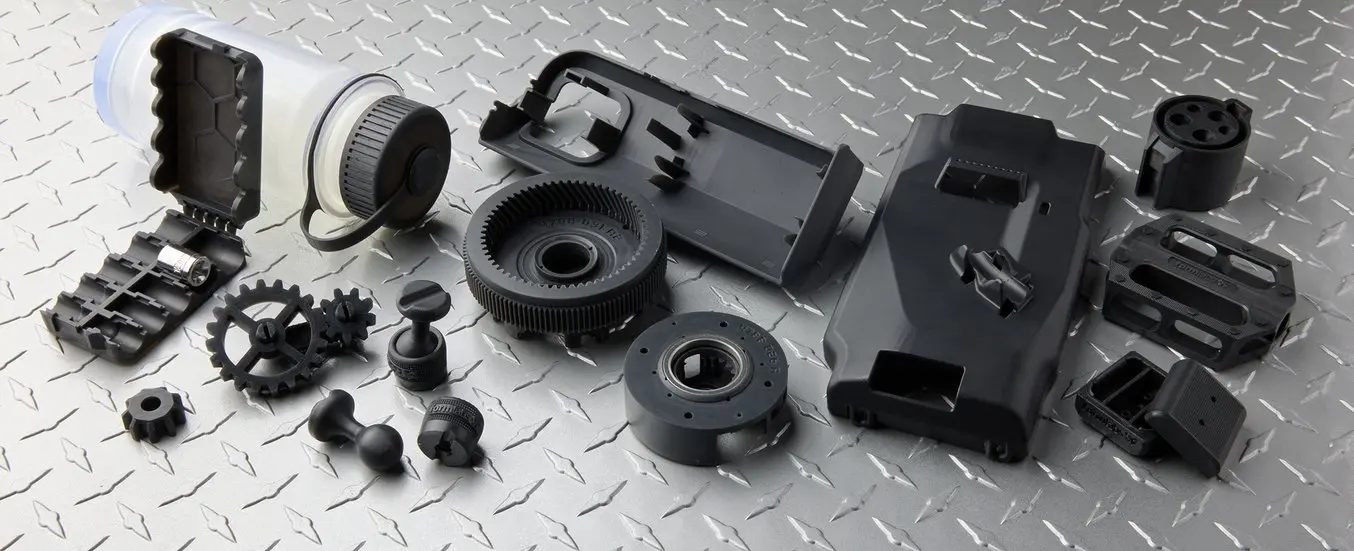
Tough 1000 Part Gallery




Tough 1000 Material Testing Videos
Related Resources
- SLA 3D printing overview
- SLA part design guide
- Accuracy of 3D printed parts
- Machine and material comparison
If you like what you see...
You should sign up for our quarterly email newsletter! We send out a summary of all the latest testing videos, design guides, and anything else cool that has been added to the F3DP website 4 times a year.
We hate spam as much as you do so we only send all killer content and no filler BS!