Honeycombing 3D Printed Parts: Less Warp, Better Accuracy, Lower Cost
Honeycombing replaces the solid core of a thick 3D printed part with a hex cell structure inside a solid outer wall. The part looks the same from the outside and stays strong, but it has far less melted material in it. That one change does three things: the part warps less, holds its dimensions better, and costs less to print.
At Forerunner 3D Printing we honeycomb MJF and SLS parts all the time, and we do it for free. Below you will find which technologies it applies to, why it works, a real example, and how to design honeycomb features.
Which Technologies Use Honeycombing?
Honeycombing applies mainly to powder bed processes. The table below shows how often we use it for each technology.
| Technology | How often we honeycomb | Why |
|---|---|---|
| HP Multi Jet Fusion (MJF) | All the time | Powder bed process with no supports. Thick parts cost more and can warp, so we honeycomb them. |
| SLS | All the time | Same powder bed benefits as MJF: less material, less heat, more parts per build. |
| SLA and DLP | Rarely | Resin parts are usually small or already thin walled. Very thick resin parts, like High Temp parts, can crack in thermal post-cure, so we shell or honeycomb those case by case. |
| FDM | No | FDM parts are already printed with an internal infill pattern. We adjust the infill instead. |
| PolyJet | Almost never | PolyJet parts are mostly small, detailed models where honeycombing doesn’t pay off. |
Why Honeycomb 3D Printed Parts?
MJF and SLS build parts by melting powder with heat. Every bit of solid material adds heat to the build and takes up room in it. Honeycombing removes melted mass, and that pays off in three equal ways:
Less Warp
The more powder we melt, the hotter the build gets. Thick, solid sections hold that heat and pull out of shape as they cool, so parts warp, twist, and move. A honeycombed part has thinner, even walls that cool more evenly.
Better Accuracy and Finish
A cooler build holds tighter dimensions. It also avoids shrink on the outside of the part, the rough surface we call elephant skin, and thermal bleed, where extra material melts onto the part surface. See our MJF accuracy figures.
Lower Cost
We charge for the material that becomes your part. The powder left in the cells gets reclaimed, and you don’t pay for it. Less melted material also means more parts fit in each build.
Honeycombed parts are also lighter, which benefits fixtures, handheld tools, and other parts that are handled frequently.
A Real Example: 40 TPU Parts on HP MJF
In the video below, our team preps a job of 40 thick TPU parts. In MJF, nesting density is how much of the build volume is melted part material. It drives both the heat in the build and the cost. TPU tops out at 12%. Nylon 12 can go to about 17 or 18%.
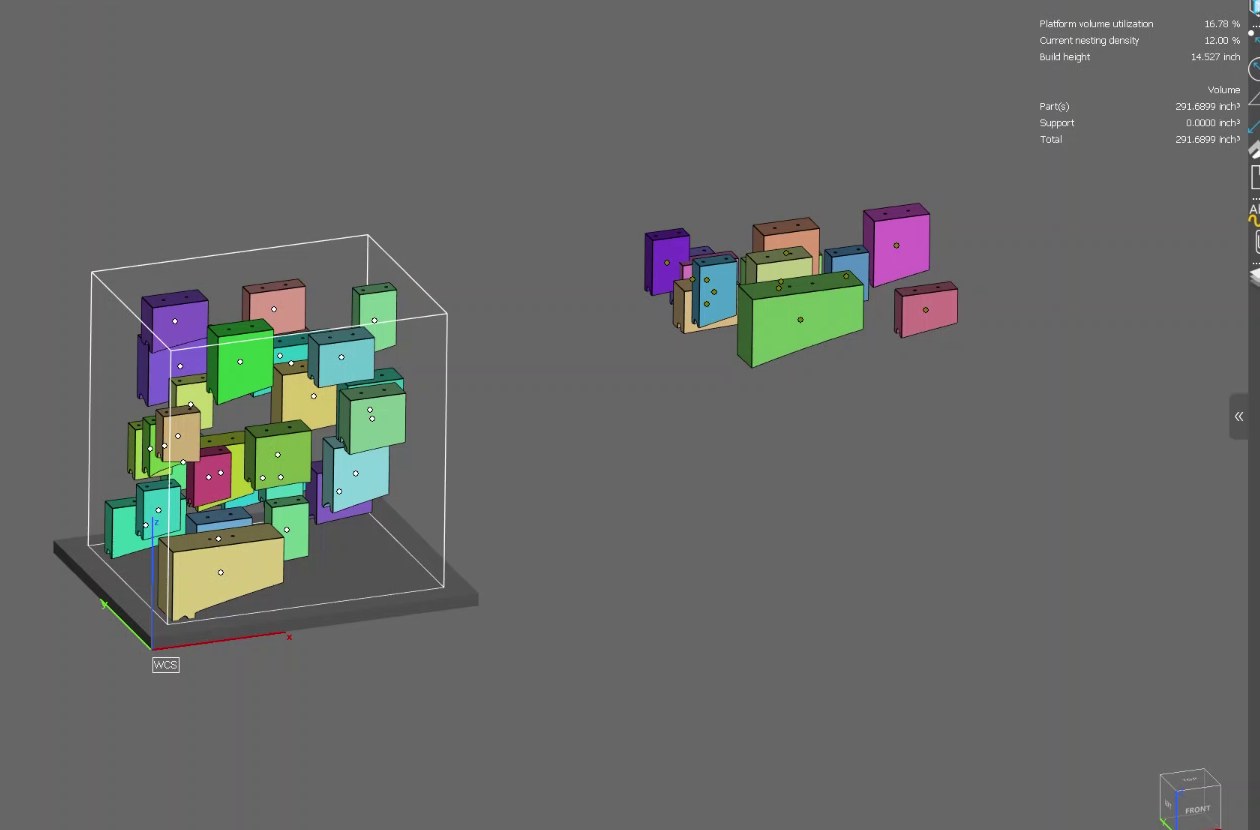
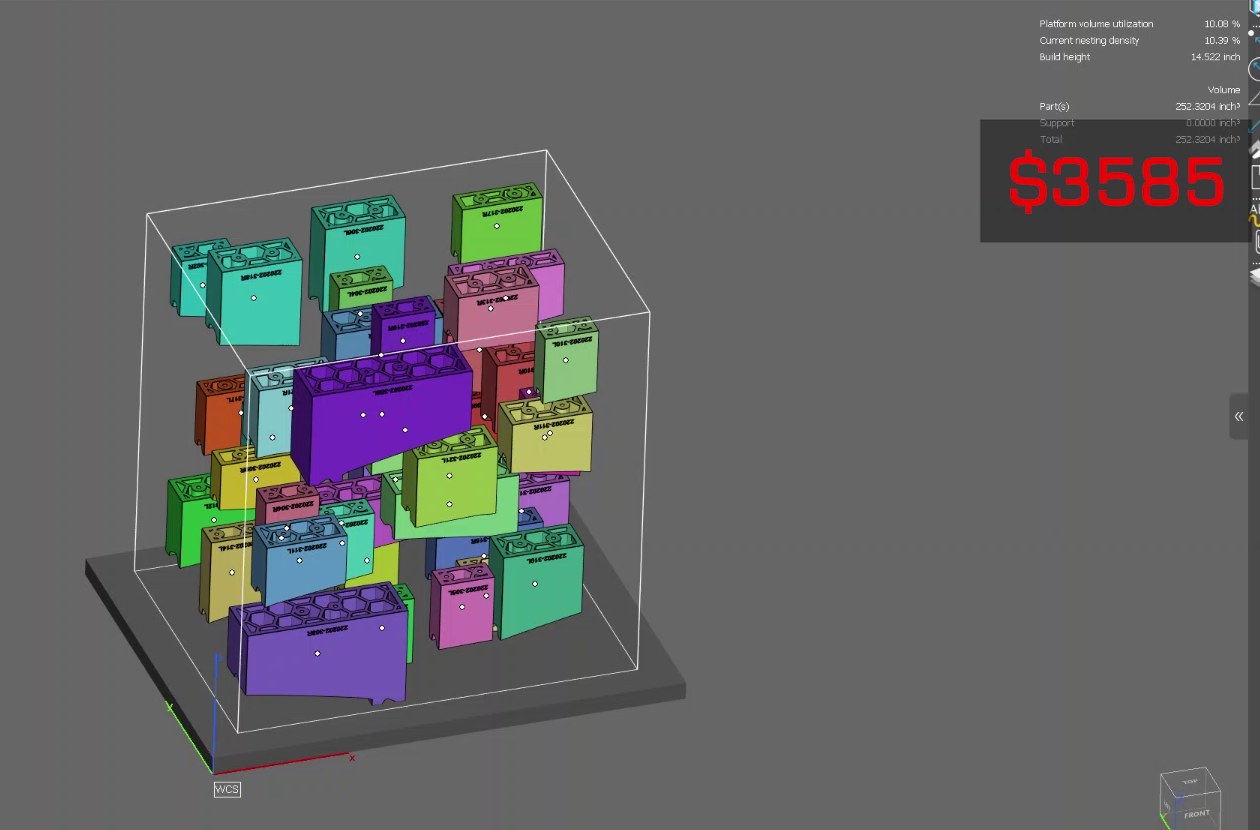
Printed solid, the 40 parts filled 16.9% of the build. That is too much melted material for TPU, so only 28 parts fit and the job needed a second build. Here is what changed once we honeycombed them in Magics, our build prep software:
| Solid parts | Honeycombed parts | |
|---|---|---|
| Nesting density (melted material) | 16.9% (limit is 12%) | 10.4% |
| Builds needed | 2 | 1 |
| Price for the first build | $3,689 (28 parts) | $3,585 (all 40 parts) |
| Price per part | $131.78 | $89.65 |
| Total for all 40 parts | close to $5,000 | $3,585 |
Honeycombing cut the melted material in the build by about 40%. The build runs cooler, so the parts warp less and hold their dimensions better. And all 40 parts fit in one build at about a third less per part.
Left: printed solid, only 28 parts fit under the density limit. Right: honeycombed, all 40 fit in one build.
Light, Medium, and Heavy Duty Honeycomb
We set up honeycomb in three strengths: light, medium, and heavy duty. Our standard cell is 1″ across the flats, and heavier duty uses thicker walls. For extra strength we can also make the cells smaller. We pick the strength with you based on how the part is used:
- High-load parts: we can use a heavier or stronger honeycomb strategy, and some parts are better printed solid.
- Low-load parts: a light duty honeycomb makes the part more accurate and less expensive.
We recommend letting us do the honeycombing. Modeling it in SolidWorks, Creo, or NX takes a long time, and it takes us minutes in Magics. If you do need to model it yourself, use these wall sizes as a starting point:
| Application | Cell size (flat to flat) | Outer wall thickness | Inner web thickness |
|---|---|---|---|
| Light duty | 1″ | .125″ | .100″ |
| Medium duty | 1″ | .1875″ | .125″ |
| Heavy duty | 1″ | .25″ | .1875″ |
How Much Does a Honeycombed Part Weigh?
We printed test blocks in MJF TPU with each of our standard honeycomb settings and weighed them. Use these to estimate what your part will weigh:
| Honeycomb | 3″ × 3″ × 3″ block | 1″ × 1″ × 1″ block |
|---|---|---|
| Light duty | 182.2 g | 10.83 g |
| Medium duty | 241.7 g | 13.62 g |
| Heavy duty | 304.48 g | 15.92 g |
Nylon 12 is slightly less dense than TPU, so a Nylon 12 part with the same honeycomb will weigh a little less. For more on the TPU blocks, see our MJF TPU material page.


Leave One End Open
Powder fills every cell during the build. One end of the honeycomb region has to stay open so we can get that powder out. If an open end won’t work for your part, talk to us. We can usually suggest another option that keeps your design intent.
Tie Holes and Bosses Into the Honeycomb
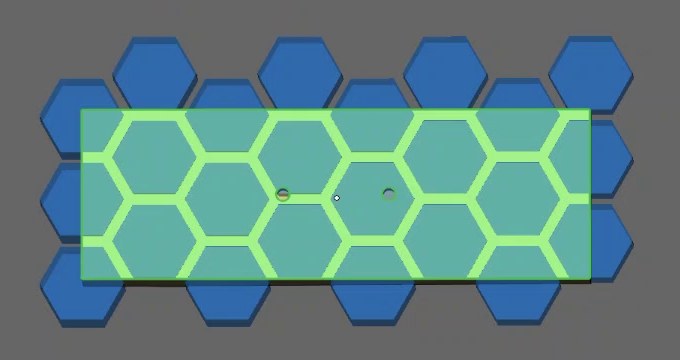
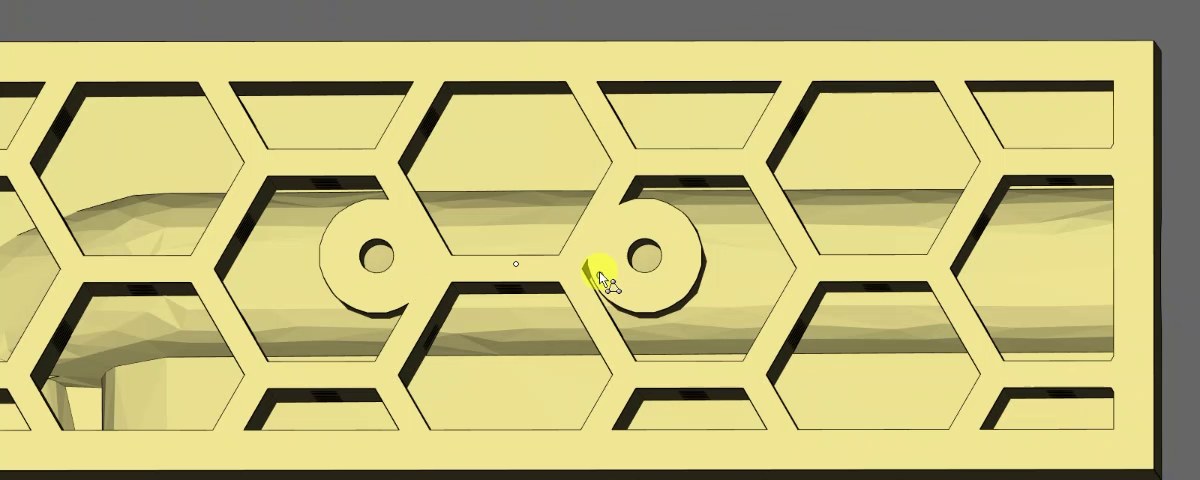
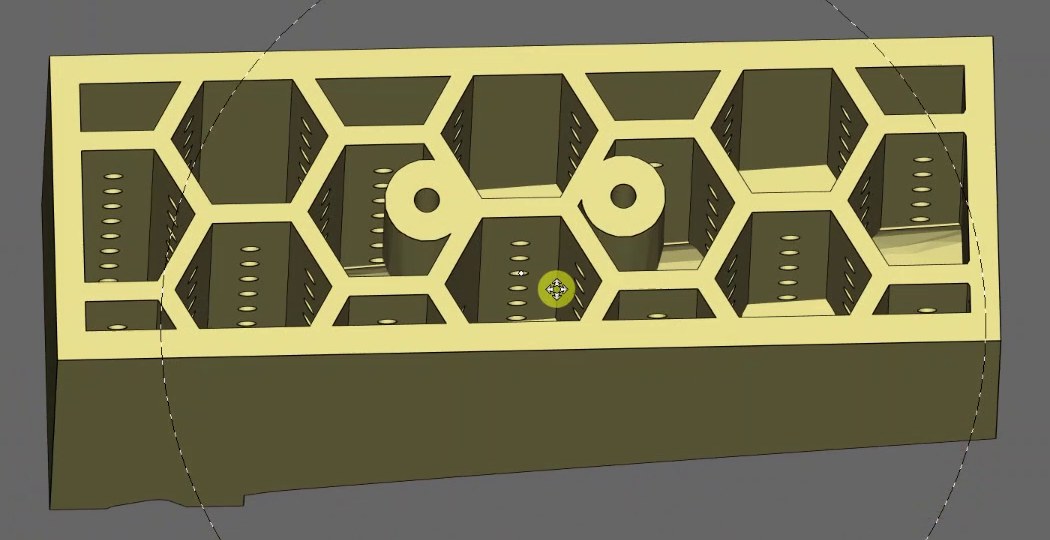
Holes, bosses, threads, and inserts stay solid, and we line up the honeycomb so those features tie into the cell walls. You can see it in the video: the two mounting holes connect straight into the honeycomb structure.
Strength
Honeycomb 3D printed parts are still very strong. We have printed thousands of honeycombed parts and very rarely see one fail. We also tested it; see the results on our MJF part wear and strength testing page.
Let Us Honeycomb It for You, Free
You don’t need to redesign anything. Send us your solid CAD file. We honeycomb parts in Magics as part of our build prep, at no charge.
When we quote a job and see a good candidate for honeycombing, we will reach out and ask if you are open to it, so we can lower your cost, make more accurate parts, and reduce quality issues. For more design rules, see our HP MJF design guide and SLS part design guide.
If you like what you see...
You should sign up for our quarterly email newsletter! We send out a summary of all the latest testing videos, design guides, and anything else cool that has been added to the F3DP website 4 times a year.
We hate spam as much as you do so we only send all killer content and no filler BS!